

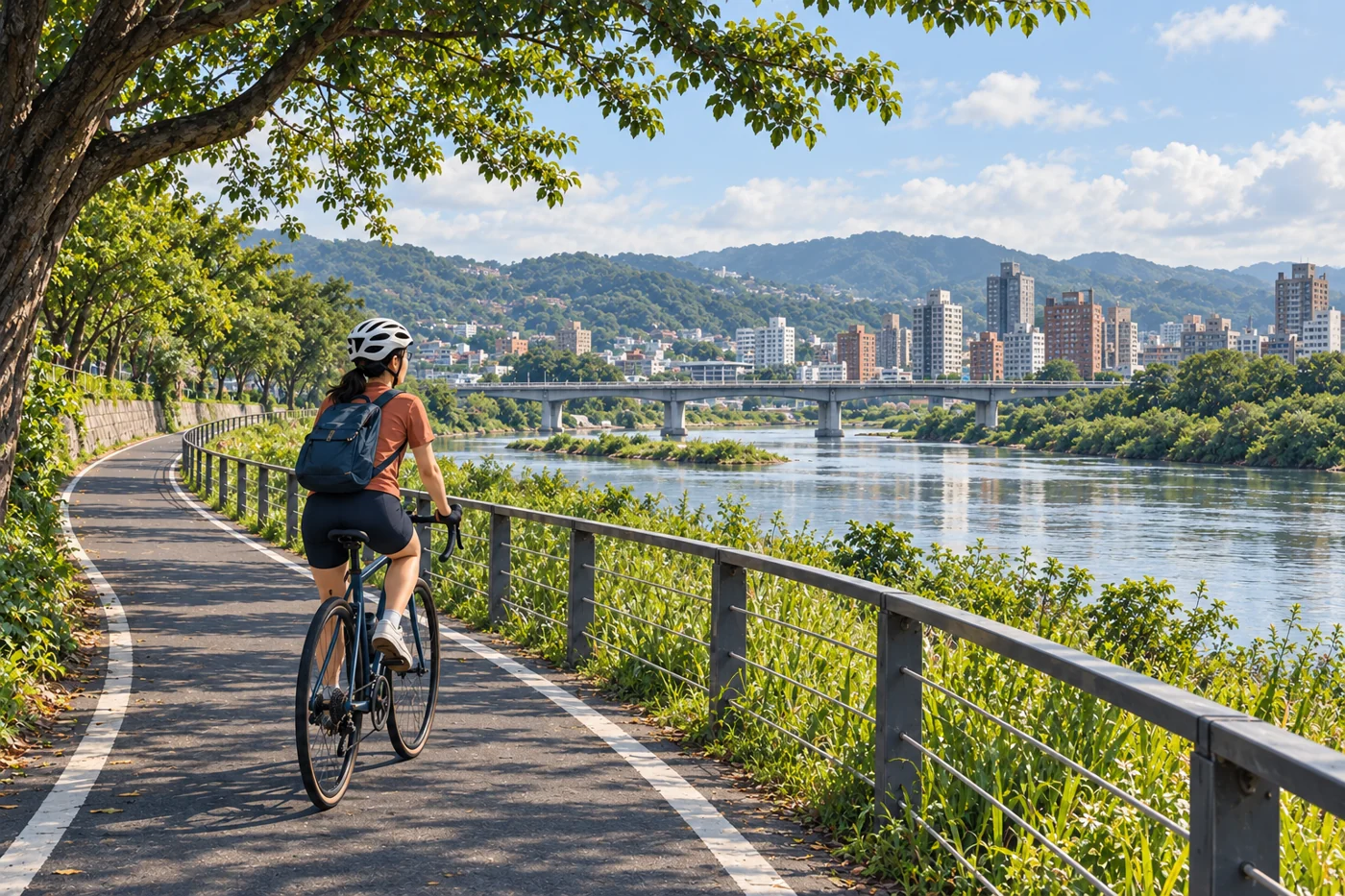
On a bicycle, a place comes past at a useful speed. You cover more ground than on foot, but a food stop, a side street or a change in the river still has time to catch your attention.
My original Taiwan cycling guide ranged from city bike rental to mountain roads. The most useful starting point is smaller: choose the ride you actually want. A short Taipei outing and a long ride through the East Rift Valley need different preparation, even when both begin with the same enthusiasm.
The Taipei cycling film below gives this guide a real place to begin. It is an earlier Amaiwan ride, not a promise that every road, shop or rental arrangement remains the same today.
Start with the city edge
For a first ride, a riverside route can be a more manageable choice than stitching together busy streets. You still need to know how you will reach the path, where you can leave it and how you will get home. A quiet-looking line on a map may have a less quiet approach.
Keep the first outing short enough to change your mind. Stop for water or something to eat, and leave time to look around. The point is to discover how riding fits your day before committing to a distance.
YouBike for a connection; a rental shop for a planned ride
YouBike is useful for short trips, but do the setup before you need the bicycle. The current single-rental instructions use the official app, email verification and a linked credit card. Check the applicable authorization, charges and return rules.
There is an important change from the old article: YouBike requires injury-insurance enrollment for rentals in Taipei, New Taipei and Taoyuan from January 1, 2026, including temporary single-rental users. Follow the current process rather than assuming that an EasyCard alone is enough. Regional subsidies and bike types differ, so the old blanket half-hour fare is not repeated here.
For a longer ride, a bicycle shop gives you an opportunity to discuss fit, gears, the route and the return arrangement. Ask what the rental includes, how a breakdown is handled and when the bike must be back. The lowest daily price tells you very little without those answers.
Let terrain decide the ambition
Taipei riverside riding: a sensible way to begin if the approach and current path conditions work for you. Treat crossings, other riders and people on foot with care. A recreational path is shared space, not a personal training course.
Sun Moon Lake: the waterside sections and a full circuit are different commitments. Use the official route information to understand the journey. Do not assume that an attractive lakeside stretch means the whole outing is flat or separated from traffic.
East Rift Valley: the farmland and mountain setting belong to the original guide’s broader Taiwan picture. Plan a specific stage, with accommodation or transport at each end, rather than adopting one large distance as a ready-made route.
The old Taroko Gorge recommendation is not carried forward as a routine cycling option. Current park and road notices must govern any plan there. Historic footage or an old tour link cannot establish present access.
Shops and small repairs are part of the journey
The original guide noted both large bicycle brands and small neighborhood repair shops. That remains a useful distinction when you are deciding where to ask for help. A specialist part, an adjustment and a simple puncture do not necessarily require the same shop.
Point to the problem, explain what happened and ask the price before work begins. A photograph or translation can help, but do not assume free labor or instant availability. The useful question is whether the shop can handle this repair, today.
A few phrases from the original guide are worth keeping:
- 壞掉了 — huài diào le — it’s broken.
- 這個可以修理嗎? — zhège kěyǐ xiūlǐ ma? — can this be repaired?
- 修理這個多少錢? — xiūlǐ zhège duōshǎo qián? — how much to repair this?
A few practical habits go a long way
Check the brakes and tires before leaving. Carry water, a charged phone and lighting if there is any chance of returning after dark. Use a helmet, leave space beside parked vehicles and slow down around intersections and pedestrians.
Rain, heat and a strong headwind can change an easy-looking ride. Build in a way to shorten the day. Do not assume bicycles can use every sidewalk or that a train will accept an assembled bike; check the rules for the route and service you intend to use.
For your own bike, a compact repair kit should suit its tires and valves. An inflator is one part of that kit. It does not fix the puncture that let the air out.
Leave room to stop
A bicycle can make a familiar place feel different without turning the day into an endurance project. Choose a route with somewhere to pause and enough time to get home comfortably.
For another day beyond the city, the Taipei day-trip guide helps separate mountain, rail and coastal outings. If you would rather stay on foot, start with one Taipei neighborhood. The pace changes; the curiosity can stay the same.
Story sources & context
Adapted from the existing Amaiwan Traveler archive. Practical details may change; follow official links before a visit.
