My Taiwan articles cover a lot of ground: rail travel, food, old streets, hot springs, and places beyond the capital. The advice I’d bring to the front is simpler. Give yourself enough time to become familiar with one small part of the place.
Start in Taipei with a neighborhood you can return to. Find a meal, notice the streets around it, and leave room for a second visit. Familiarity can be as useful as another destination.
Let an ordinary meal be part of the story
The food list in my earlier Taipei article included dumplings, steamed buns, lunchboxes, scallion pancakes, and fruit shaved ice. Those are useful starting points because a day of eating doesn’t have to revolve around one famous restaurant.
Choose something you’re curious about and take time with it. Watch how people order and where they eat. A lunchbox or a plate of dumplings can give the day a rhythm without becoming a project of its own.
Choose one market for the evening
Raohe and Tonghua, also called Linjiang, both appeared in the original Taipei guide. Give one market the evening rather than trying to compare several in a rush. At Raohe, the Songshan station area offers a practical arrival point; the market brings shops and food stalls into a concentrated stretch of street. Taiwan’s tourism page has location and transport information.
Look beyond the food you came for. Notice where a queue forms, where people step aside, and how the shops and stalls fit together. It’s a busy environment, so a slower visit may mean stopping at the edge rather than standing in the flow.
Give the old streets their own time
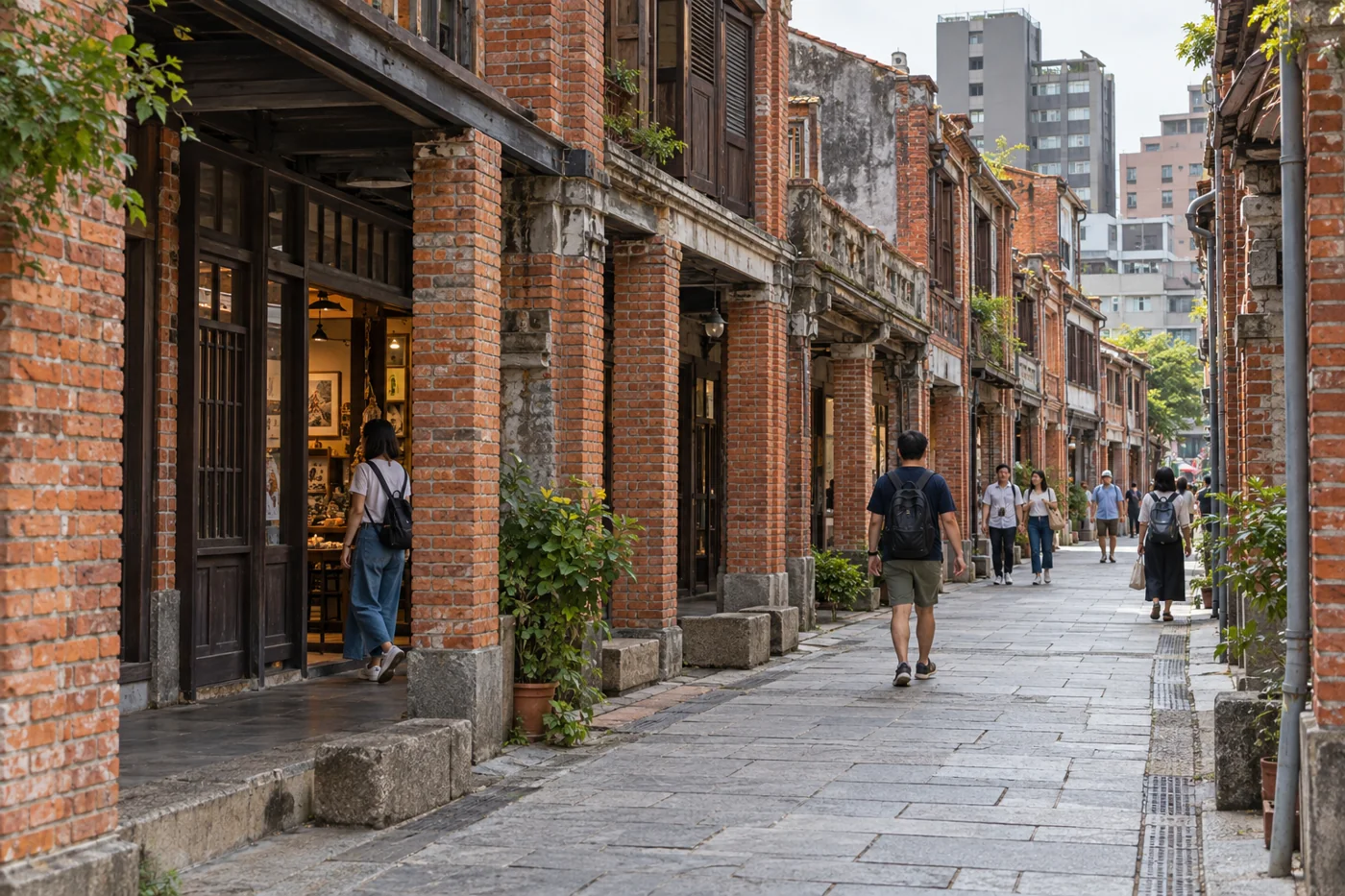
The earlier articles pointed toward neighborhood temples and older streets as places to notice Taiwan’s history. Approach them with curiosity, and remember that a temple can be a place of worship in the middle of an ordinary day. Follow posted guidance and leave people room to go about their visit.
For a different setting, consider Tamsui in New Taipei City. Its old street and riverside walkway offer two ways to explore the same area: shops and food on one side, a broader view of the river on the other. The New Taipei visitor page describes the area. Let it be an outing of its own.
Keelung is a separate chapter
Keelung’s Miaokou market has a particular place in my earlier Taiwan guide, and I linked my walk through the port city there. Keelung is its own city, not a Taipei neighborhood. Plan the journey and the return before adding it to your stay.
For a first visit, keep the useful tools close: a map, a translation app, and your transport plan. An EasyCard can simplify Taipei MRT travel; check the official Metro introduction for ticket information. You don’t need to cross the island to begin understanding Taiwan. Start with a meal and a few streets. Come wander with me!
Three Taipei outings with different rhythms
For everyday shopping, begin with Longquan Market in the Shida area. For history you can trace through the streets, choose the West Taipei walk. For a modern landmark seen from the ground, follow the Taipei 101 story into Xinyi.
Each deserves its own time. With one day, choose a neighborhood and a meal, then decide whether you still want an evening outing. With three days, give one to the older west, one to everyday neighborhood life, and one to the modern east or a place you want to revisit. This leaves room for weather and the discoveries you cannot schedule.
Keep the city and the day trips distinct
Jiufen, Shenkeng, Sanxia, and Yingge are in New Taipei City; Keelung is a separate city. The original broad guide included them alongside Taipei, but they need separate travel planning. Avoid pairing distant places just because they appear next to each other in an article.
For city travel, use the Taipei Metro website for current route and fare information. Locate your destination’s entrance, not just its nearest station. A practical base gives you food, transit, and an easy way back when you have walked enough.
Story sources & context
Adapted from the existing Amaiwan Traveler archive. Practical details may change; follow official links before a visit.